Best Classroom Bingo Resources for Teachers (2026)
Classroom bingo has been a teacher staple for decades, but the resources available in 2026 — from edtech review sites to subject-specific lesson libraries — have made it more versatile than ever. Whether you are teaching vocabulary to second graders, reviewing grammar with ESL learners, or looking for a first-day icebreaker, there is a growing ecosystem of educators writing about how they use bingo well.
This guide collects the best sites, blogs, and tools for teachers who want to go beyond generic number bingo and actually use the format to drive learning outcomes.
Top Education Blogs Writing About Classroom Bingo
Several education bloggers have written substantively about bingo as a pedagogical tool — not just as filler, but as a structured activity tied to specific learning goals.
Gifted Guru
Gifted Guru, run by Lisa Van Gemert, is one of the most thoughtful resources for teachers of advanced learners. Her writing on bingo in the classroom goes beyond surface-level game mechanics — she addresses how to design clues that stretch gifted students rather than bore them, how to use bingo for vocabulary depth rather than just recall, and how the social dynamics of a game can be leveraged in differentiated classrooms. If you teach a pull-out gifted program or a self-contained advanced class, her tips for bingo are worth reading before you design your first card.
Educators Technology
Educators Technology is one of the most reliable edtech review blogs operating today. The site curates tools, apps, and classroom strategies across grade levels and subject areas, making it a useful first stop when evaluating any new classroom technology including bingo generators and game-based learning platforms. Their reviews are grounded and practical rather than promotional.
Book Units Teacher
Gay Miller's Book Units Teacher is a treasure for ELA and reading teachers. Her site includes a comparison of bingo generators specifically aimed at teachers who want to create cards tied to book vocabulary, character names, or plot events. If you teach novel units and want bingo cards that reinforce reading rather than distract from it, her breakdown of which tools give you the most control over content is genuinely useful.
WeAreTeachers
WeAreTeachers is a large teacher resource community with free printables, classroom strategies, and a consistently practical tone. Their icebreaker bingo content is particularly strong — they cover first-day-of-school formats, getting-to-know-you cards, and community-building games for the beginning of a semester. They also maintain a broad library of free teacher resources across subjects and grade levels.
Cult of Pedagogy
Jennifer Gonzalez's Cult of Pedagogy is widely considered one of the best education blogs for working teachers. Her writing on active learning, classroom engagement, and practical instructional strategies provides the kind of theoretical grounding that helps teachers understand not just what to do but why it works. Bingo fits naturally into her broader framework for turning passive review sessions into genuine learning activities.
Lucky Little Learners
Lucky Little Learners is a widely followed resource for elementary teachers, and Jess Dalrymple's 15 Fun Literacy Activities for 2nd Grade is a strong example of how bingo earns a place in a literacy block. Her phonics bingo activity has students build their own cards, which turns a review game into focused word work. It is a practical companion for any teacher planning hands-on second-grade reading practice.
Best Resources for ESL Bingo
ESL teachers have developed some of the most creative adaptations of classroom bingo, because the format maps well onto language acquisition: students hear a word or phrase, recognize it visually, and respond — exactly the loop that builds vocabulary retention.
BusyTeacher.org
BusyTeacher.org is a community-driven ESL resource library with thousands of printable worksheets and lesson plans contributed by working teachers. Their bingo section covers a wide range of English language contexts: greetings bingo, classroom objects, verb conjugations, irregular past tenses, and more. The site is particularly valuable for teachers who want ready-to-use printable cards without building from scratch.
ESL Speaking
ESL Speaking focuses specifically on spoken English activities, and their bingo content reflects that emphasis. Their ESL bingo activities are designed to get students talking — calling out answers, negotiating what counts, and describing what they heard — rather than sitting quietly and marking cards. For teachers focused on communicative language teaching rather than passive review, their approach to bingo activities is worth studying.
Mrs Learning Bee
Mrs Learning Bee, run by Tam Milledge, covers quick classroom games and digital teaching tools for primary school teachers. Her roundup of the top 30 classroom games includes bingo as a go-to format for review sessions, and she regularly evaluates new edtech tools for practical classroom use. For teachers who want game ideas that actually work in a 10-minute window, her blog is a consistently useful resource.
Ditch That Textbook
Ditch That Textbook, run by Matt Miller, is one of the most widely read edtech blogs in education. His comprehensive comparison of classroom game platforms — covering Kahoot, Quizizz, Blooket, Gimkit, and more — is a definitive resource for teachers evaluating which digital tools to adopt. His framework for assessing classroom technology applies directly to bingo platforms as well.
EdTech Review Sites and Tool Databases
Beyond individual bloggers, several curated databases and edtech review platforms serve as useful references when evaluating classroom bingo tools.
TeachersFirst
TeachersFirst is a long-running educator tool database that reviews and catalogues classroom technology across categories. Their editorial team evaluates tools for pedagogical soundness, ease of use, and grade-level appropriateness — a more rigorous process than user-submitted app stores. For teachers researching game-based learning tools, it provides a curated starting point rather than a raw search result list.
TeachThought
TeachThought regularly publishes lists of essential edtech tools and modern learning strategies. Their coverage of game-based learning and classroom engagement tools contextualizes bingo within broader shifts in how teachers approach active learning. When evaluating whether a tool fits your instructional approach, their framing of what makes technology pedagogically useful is a good lens to apply.
TCEA TechNotes Blog
The TCEA TechNotes blog is the content arm of the Texas Computer Education Association, one of the largest state-level edtech organizations in the US. Their posts on classroom game tools, digital review activities, and teacher professional development reflect what is actually being adopted in K-12 schools at scale, not just what is being discussed in theory. A useful reference for understanding what classroom technology looks like when it is deployed across a real district.
Getting Smart
Getting Smart is an edtech thought leadership publication covering innovation in learning, school design, and educational technology. Their coverage includes emerging platforms, game-based learning research, and profiles of schools using technology well. For teachers who want to understand the broader trajectory of classroom tech — where bingo tools fit into the larger picture of personalized and game-based learning — Getting Smart provides that context.
todoELE
todoELE is a long-running curated directory of digital tools and materials for language teachers, organized by platform, price, and pedagogical use. Its digital-tools section catalogs bingo and vocabulary-game applications the way an activity director would shortlist them, which makes it a useful reference for teachers comparing classroom bingo options across languages.
Beyond the Classroom: Bingo for Teams and Events
The bingo format has migrated well beyond K-12 classrooms. The same mechanics that make it effective for student review — low barrier to entry, social engagement, competitive structure — transfer to professional onboarding, team-building workshops, and corporate events.
TeamBuilding.com has documented how icebreaker bingo works in professional settings: virtual team introductions, in-person company events, and hybrid meetings where some participants are remote. Their guides on running bingo as a team-building activity are worth reading if you are a teacher who also runs professional development sessions or coaches new staff orientations. The facilitation techniques transfer directly.
What Modern Bingo Tools Offer
The resources above describe strategies and ideas, but the quality of the tool you use to build and run the game still matters. The most time-consuming part of classroom bingo historically has been card creation — either hand-writing cards, using a basic grid template, or managing a printer that runs out of paper on game day.
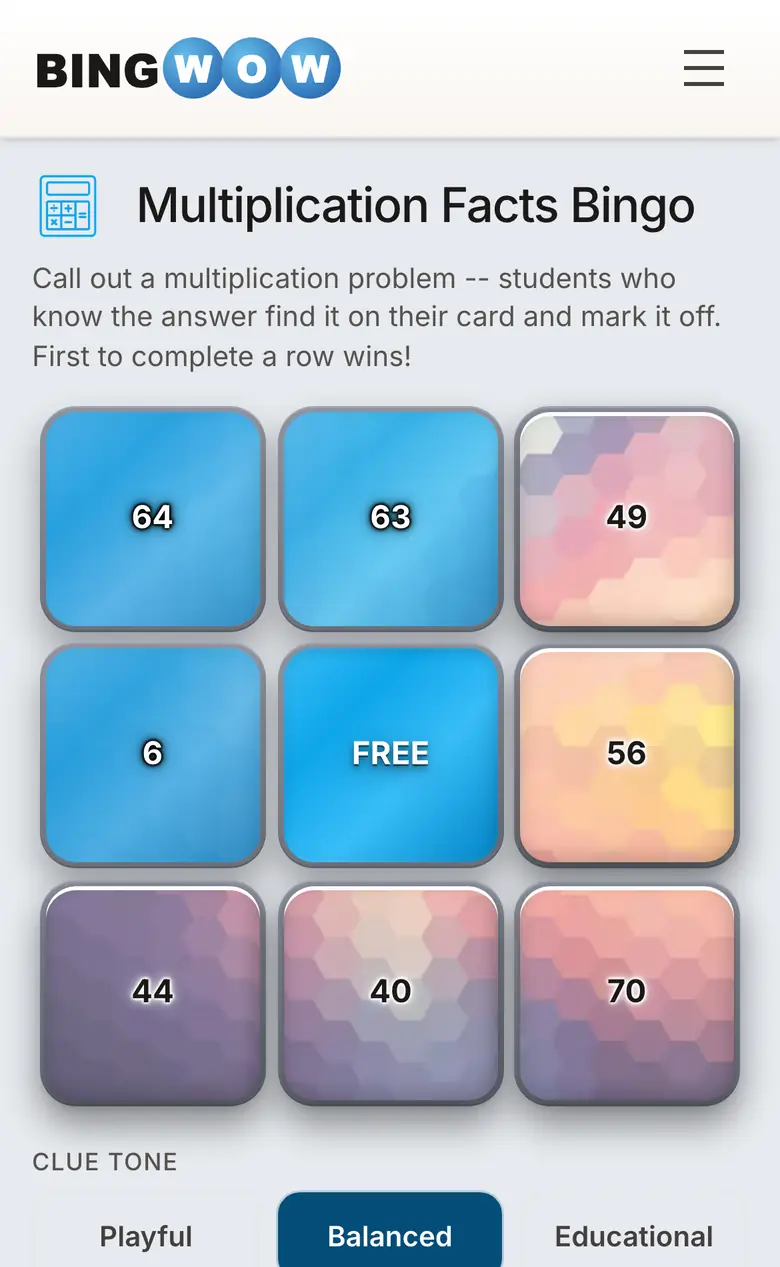
Modern tools solve different parts of that problem in different ways. BingWow takes an AI-first approach: you describe the topic (a vocabulary list, a set of math facts, a reading unit's characters), and the tool generates a full set of bingo clues, assigns them to randomized cards, and lets students play on their own devices in real time. Key features that matter for classroom use:
- AI clue generation — enter a topic or paste a word list and get a complete card set without building it cell by cell
- Multiplayer rooms — students join with a code, each get a unique card layout, and the teacher calls from the same screen
- Free PDF printing — for classrooms without reliable 1:1 device access, cards export to print-ready PDFs with unique layouts per sheet
- Wildcard mode — each player gets a partially unique clue set, increasing replay value and preventing the entire class from winning simultaneously
For most classroom use cases, the free tier covers everything you need. No account required for students to join a live game.
The Bingo Ecosystem Is Growing
Classroom bingo is not a new idea, but the infrastructure around it — the blogs documenting best practices, the ESL communities sharing adaptations, the edtech databases cataloguing tools, the corporate trainers extending the format into professional settings — has grown substantially. Teachers in 2026 have access to a much richer set of resources than their predecessors did.
The sites listed in this guide represent the best of that ecosystem: educators writing honestly about what works, tool reviewers applying real pedagogical criteria, and communities of practice sharing what they have actually tried in classrooms. Bookmark the ones that match your subject area and grade level, and return to them when you are planning your next unit review or looking for a first-day activity that actually gets students talking.