Skip to content

Free Adapted Bingo for Special Education & IEP Goals

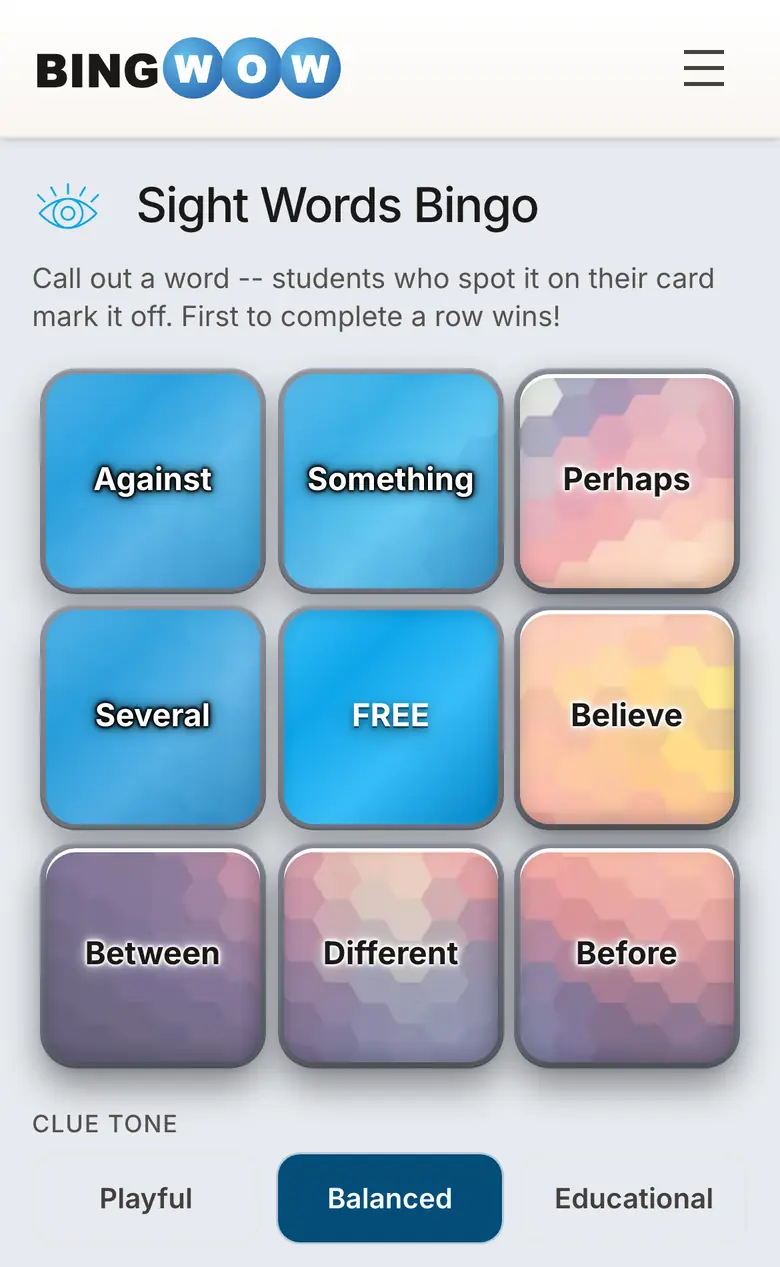
Smaller grids (3×3) for cognitive load. Picture cards for non-readers. Visual schedules that match TEACCH-style structure. Repeatable formats students recognize from session to session. BingWow adapts to the student — not the other way around.

Special education teacher working with student on bingo card

Adapted Bingo by Goal Type

Key Facts

SpEd enrollment

7.5 million US students received services under IDEA in 2022-23 — 15% of all public school students, with autism, speech/language, and specific learning disabilities the three largest categories

Source: National Center for Education Statistics, 2024

3×3 grids reduce cognitive load

BingWow defaults to 3×3 (9 cells) on mobile — useful for students with attention or working memory IEP goals. 4×4 and 5×5 are available when wider exposure is appropriate.

Source: bingwow.com

Predictable repeat sessions

Same format every week. Same rules, same layout, same call-and-mark rhythm. Students with autism, ADHD, or anxiety benefit from predictable routines — bingo is one of the few games where week-to-week repetition is a feature, not a bug.

Source: TEACCH structured teaching principles

Research-backed

Our analysis of 20 EdTech tools is published on SSRN (Elsevier). Three peer-reviewed meta-analyses confirm large effect sizes for game-based learning across general and special education populations.

Source: SSRN Abstract 6566559

Frequently asked questions

How do I adapt bingo for students with IEPs?
Start with a 3×3 grid (9 cells) to reduce visual complexity. Use picture cards for pre-readers or students with reading goals below grade level. For students with auditory processing goals, show the clue on a screen instead of (or alongside) saying it aloud. For motor goals, use large daubers or dot stickers instead of pencils. The game stays the same; the inputs adapt.
Can I use bingo for autism social skills practice?
Yes. Pair the game with explicit turn-taking practice — wait for the caller, wait for the mark, wait for the next call. Some teachers use a visual timer alongside the game. For higher-functioning students, social-skills bingo cards (with squares like "asked a friend a question" or "said please") turn the game itself into a social-skills practice tool.
How do I run bingo with non-verbal students?
Use picture bingo with a touch device or laminated card and a dauber. The student matches the image to the calling card without needing to say or read the word. For mixed groups (some verbal, some non-verbal), the teacher calls aloud AND shows the picture, so every student has an access point.
Is BingWow free for special education teachers?
Completely free. No subscription, no per-student license, no premium tier. Print unlimited cards, run as many sessions as you want, use 3×3 / 4×4 / 5×5 grid sizes interchangeably. Built explicitly to remove cost as a barrier in classrooms that already have one.

Related Articles